







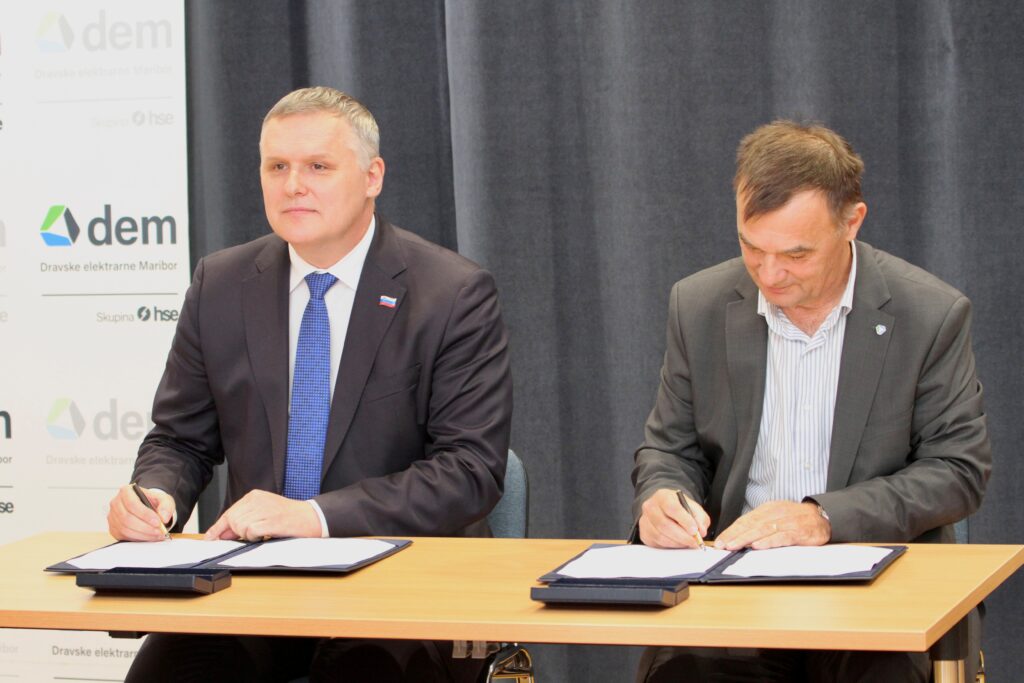
Today, the Minister of the Environment, Climate and Energy, Mag. Bojan Kumer, and the Director General of DEM, Andrej Tumpej, signed a contract on co-financing a solar power plant at the closed Pobrežje landfill (SE ZOOP). By signing the contract, they officially confirmed the commencement of the implementation phase of the project, which is being carried out under the Modernisation Fund and is one of the most important examples of sustainable transformation of brownfield areas in Slovenia.
The SE ZOOP project will be positioned in a closed landfill in Maribor, whereby DEM, which is part of the HSE Group, will provide the brownfield area with a new, developmental, and sustainable function. The solar power plant with a rated capacity up to 10 MW will produce approximately 12 GWh of electricity annually. This will flow directly into the grid, significantly increasing electricity production from renewable sources in the urban environment.
According to the investment plan, the total value of the investment is approximately EUR 9.6 million, of which almost EUR 4 million will be provided from the Modernisation Fund of the Republic of Slovenia, and the remainder will be financed by DEM.
When signing the contract, the Minister of the Environment, Climate and Energy, Mag. Bojan Kumer, pointed out: “The solar power plant project at the closed Pobrežje landfill is the first in Slovenia to utilise options provided by the Act on the Introduction of Installations for the Production of Electricity from Renewable Energy Sources for closed landfills. Such projects are used to give brownfield areas a new developmental function, while increasing domestic production of clean electricity. Slovenia has 63 closed landfills, and I believe that this project can set an example for numerous similar projects throughout the country.”
The Director General of DEM, Andrej Tumpej, emphasised: “The SE ZOOP project has a special strategic importance for our company, as it brings together our key guidelines: to increase electricity production from renewable sources, sustainable use of space, and responsible environmental management. It is also crucial from the aspect of further diversification of our production portfolio, and the long-term planning of energy development.” Mr Tumpej thanked the employees participating in the preparation of the project, and pointed out that their expert work, coordination, and technical solutions are facilitating the successful implementation of the investment.
In his address to the participants, the CEO of HSE, Dr Tomaž Štokelj, stated: “The HSE Group is the spearhead of Slovenia’s green transition, in which solar power plants play an important role. The Puhova solar power plant, which will be located at the closed landfill in Pobrežje in Maribor, is one of the successful examples of placing an energy facility in a brownfield area. A similar investment has been made in Prapretno, where an expansion is underway, and further investments are planned in Dekani and Zagorje ob Savi. In this way, former brownfield areas gain new development opportunities, and an important role in the country’s green transition and strengthening its energy resilience.”
Currently, contractors are being selected within the SE ZOOP project, pursuant to the Public Procurement Act. Today’s signing of the contract on co-financing from the Modernisation Fund of the Republic of Slovenia is a crucial step toward the project’s implementation, which will commence in the first half of 2026. The conclusion of the project and the start-up of the power plant are planned for the end of 2027.
This significant investment reaffirms the commitment of DEM, the HSE Group, and the Government of the Republic of Slovenia to further invest in the production of clean electricity from renewable sources, and confirms a strategic orientation towards sustainable and innovative solutions on the path to climate neutrality.